Why Are There So Many Shingle Granules in My Gutters?
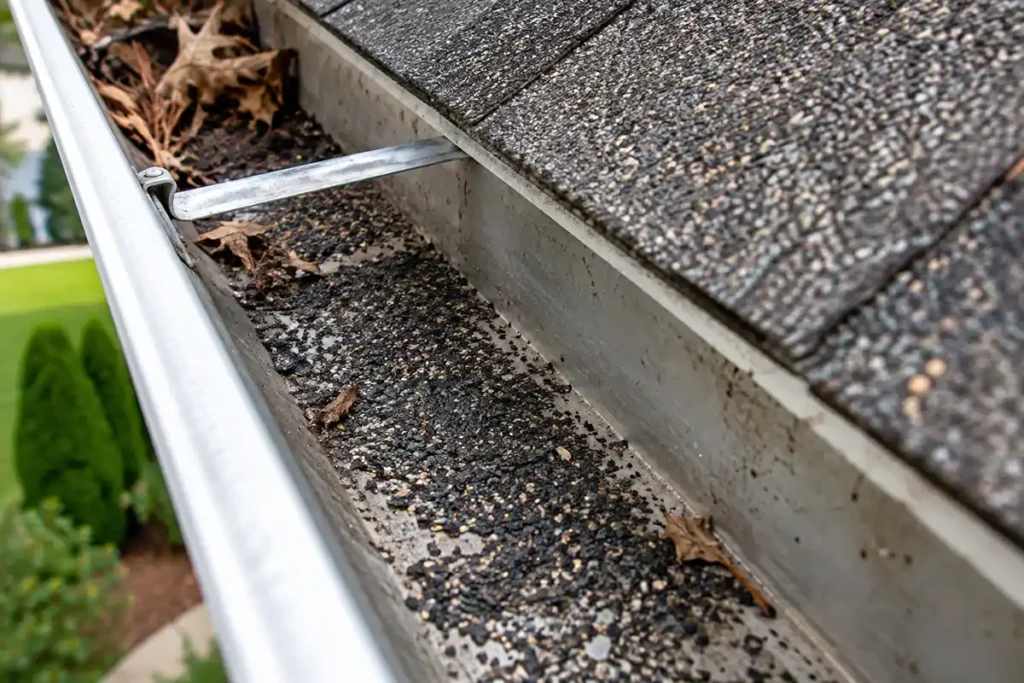
You’re cleaning the gutters and notice something unexpected at the bottom: a layer of small, coarse granules that look a little like black or colored sand.
Look up at your roof and you may quickly figure out where they’re coming from.
Those are the protective granules from your asphalt shingles.
Finding some shingle granules in your gutters is normal. Finding a lot of them can be a sign that your roof is aging, wearing faster than it should, or has recently been damaged.
So how much is too much, and when should a Minnesota homeowner have the roof inspected?
What Are the Granules on Asphalt Shingles?
The rough surface on an asphalt shingle isn’t there just for appearance. Those tiny mineral granules are an important part of the roofing system.
They help protect the asphalt underneath from sunlight and ultraviolet exposure, add durability to the shingle, and give the roof its color and finished appearance.
As shingles age and weather, some of those granules inevitably loosen. Rain then washes them down the roof and into your gutters.
That’s why seeing some granules in your gutters doesn’t automatically mean something is wrong.
Is It Normal to Find Shingle Granules in the Gutters?
Yes, particularly in certain circumstances.
A relatively new asphalt roof may shed some loose granules left over from the manufacturing, handling and installation process. Finding some of those granules in the gutters doesn’t mean your new roof is already failing.
Older shingles also naturally lose granules gradually as they weather.
The more important questions are how many granules you’re finding, whether the amount has suddenly increased, and what the shingles themselves look like.
Why Am I Suddenly Finding More Granules?
If you’ve cleaned your gutters before and suddenly notice considerably more granules than usual, there are several possible explanations.
- The roof is getting older. As asphalt shingles age, their bond with the surface granules can deteriorate.
- The roof has experienced hail. Hailstones can strike the shingle surface and dislodge protective granules.
- Severe weather has accelerated normal wear. Minnesota roofs experience strong winds, heavy rain, hail, heat, cold and dramatic temperature changes.
- The shingles may be deteriorating. Excessive granule loss can occur as shingles approach the end of their useful service life.
- The roof is relatively new. Some initial shedding can simply be loose granules working their way off newly manufactured and installed shingles.
The granules in the gutter are therefore a clue, not a diagnosis.
Can Summer Hail Cause Granules to Come Off My Roof?
Absolutely.
This is particularly relevant during early fall in Minnesota because your roof may have gone through several summer thunderstorms before you get around to cleaning the gutters.
When hail strikes an asphalt shingle, the impact can knock away granules and damage the material underneath. Some of those loosened granules eventually wash into the gutter.
You may not have noticed anything unusual immediately after the storm.
Then September or October arrives, you clean the gutters and suddenly wonder why there’s so much “sand” at the bottom.
If you notice an unusual amount of granules after a known hailstorm, it may be worth having the roof inspected for storm damage.
How Can I Tell If My Roof Is Losing Too Many Granules?
The gutter isn’t the only place to look.
From the ground, look at the roof in good daylight. You don’t need to climb onto it.
Signs that deserve a closer inspection can include:
- Areas of shingles that appear lighter or darker than the surrounding roof
- Visible bald or thin spots on individual shingles
- Exposed asphalt where granules have disappeared
- Large quantities of granules repeatedly accumulating in gutters
- Granule loss concentrated in particular areas rather than evenly across the roof
- Shingles that are also curling, cracking or deteriorating
- A noticeable increase in granules following a hailstorm
One of these signs by itself doesn’t necessarily mean you need a new roof. Several of them together can tell a different story.
Does Granule Loss Mean I Need a New Roof?
Not necessarily.
This is where homeowners can get into trouble trying to diagnose a roof from one symptom.
A handful of granules in the gutter isn’t a reason to replace a roof. Even a larger amount doesn’t tell you everything without considering the age and condition of the shingles and whether the roof has experienced recent storm damage.
On the other hand, widespread granule loss on an older roof can be an indication that the shingles are approaching the end of their useful life.
The condition of the roof itself matters more than the collection of granules at the bottom of the gutter.
Why Does Losing Granules Matter?
Once enough granules disappear, the asphalt portion of the shingle becomes more exposed to sunlight and weather.
That can accelerate deterioration.
Think of the granules as part of the shingle’s protective outer layer. Losing a few doesn’t destroy that protection. Losing enough of them over a large area can compromise it.
That’s why excessive granule loss is something a roofer considers when evaluating the overall condition of an asphalt roof.
What If Only One Part of the Roof Is Losing Granules?
Uneven granule loss can be especially useful information.
Different sections of a roof can age at different rates because of sun exposure, slope, drainage, ventilation and weather exposure.
Localized damage can also point toward a specific event or problem rather than normal aging across the entire roof.
If one slope or one area looks noticeably different from the rest, that’s worth pointing out when the roof is inspected.
Should I Climb Onto the Roof to Check?
We don’t recommend climbing onto your roof simply to investigate granule loss.
A roof can be steep, slippery and considerably less forgiving than it looks from the ground. Walking on aging shingles can also cause additional granule loss.
You can learn quite a bit by looking from the ground, checking what is accumulating in accessible gutters and having an experienced roofing contractor inspect the roof when something doesn’t look right.
Fall Is a Good Time to Pay Attention to What Your Gutters Are Telling You
Cleaning gutters in the fall isn’t only about getting leaves out before winter.
It gives you an opportunity to see what’s been washing off your roof all summer.
Leaves, twigs and ordinary debris aren’t particularly surprising. A large accumulation of shingle granules deserves a little more attention.
That doesn’t mean you should panic or assume you’re about to buy a new roof.
It means you’ve found a reason to take a closer look.
Have Your Minnesota Roof Checked Before Winter
If you’re finding an unusual amount of shingle granules in your gutters, Minnesota Metal Exteriors can inspect the roof and help determine why they’re coming off.
It may simply be normal shedding. It could be an aging roof. It could also be evidence of damage from one of Minnesota’s summer storms.
The important thing is figuring out which one it is before a small roofing problem spends another Minnesota winter exposed to snow, ice and freezing temperatures.
Minnesota Metal Exteriors provides roof inspections, roof repair, storm-damage services, asphalt roofing and metal roofing throughout the Twin Cities, Greater Metro and North Central Minnesota.
If you’re seeing more granules than usual or something about your roof doesn’t look right, contact Minnesota Metal Exteriors and have an experienced roofing contractor take a look.