When You Hire a Roofing Company, Who Actually Does the Work?
When you hire a roofing company, you probably assume you’re hiring that company to install your roof.
That’s not always how the roofing business works.
In fact, the person who comes to your house, inspects your roof, gives you an estimate, and asks you to sign a contract may never drive a nail, install a panel, or even be present when your new roof goes on.
There can be several layers between the homeowner who is paying for the roof and the people who actually install it.
That doesn’t necessarily mean there’s anything wrong with the company. Subcontracting is common throughout the construction industry, and there are excellent subcontractors doing excellent work.
But as a homeowner, you should understand who you’re actually hiring and who will actually be on your roof.
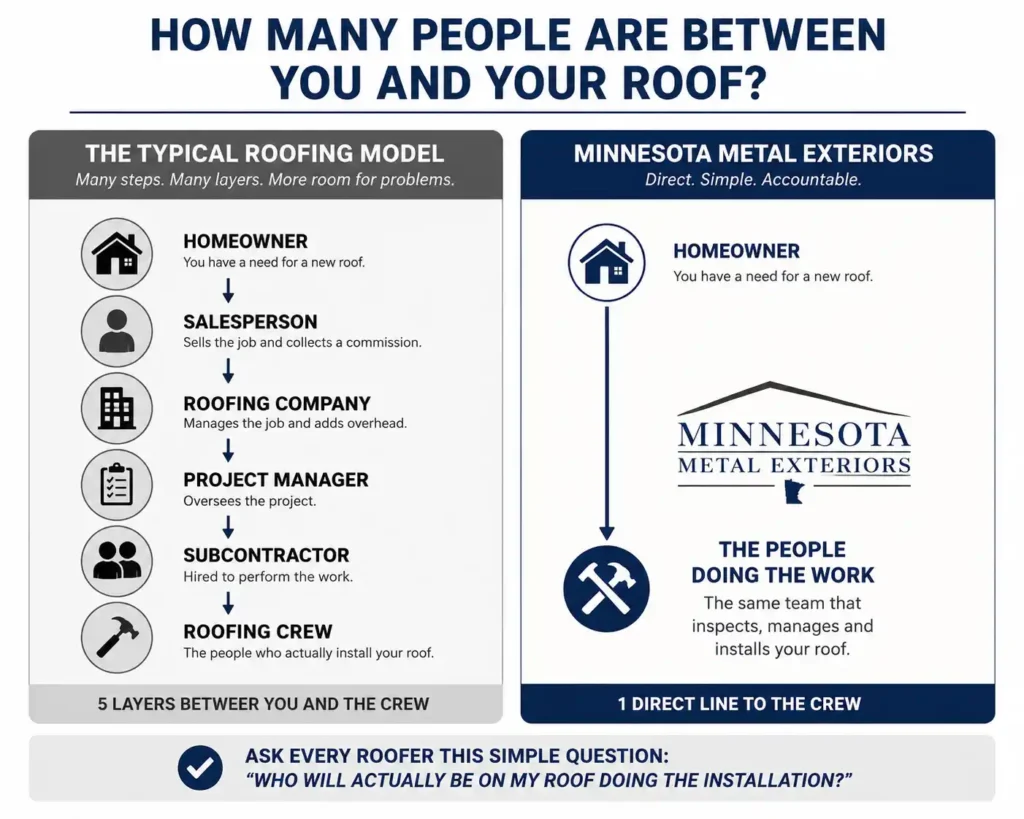
How Many People Are Between You and Your Roof?
A common roofing business model can look something like this:
Homeowner → Salesperson → Roofing Company → Project Manager → Subcontractor → Installation Crew
The salesperson finds the customer and sells the project. The roofing company handles the contract and administration. A project manager may coordinate the job. The installation itself may then be assigned to a subcontractor, who provides the crew that actually installs the roof.
Every one of those people has a legitimate job to do.
But every additional layer also creates another place where communication can break down, responsibility can become unclear, and overhead gets added to the cost of the project.
The Person Selling Your Roof May Not Be a Roofer
This surprises a lot of homeowners.
Some roofing salespeople are extremely knowledgeable about roofing. Others are primarily salespeople.
Their job is to generate leads, meet homeowners, present products, prepare proposals, and close sales.
Once the contract is signed, the project may be handed to someone else.
That person may hand it to someone else.
Eventually, an installation crew arrives at your house.
That’s when you may discover that the people installing your roof aren’t actually employees of the company whose name is on your contract.
Subcontracting Isn’t Necessarily Bad
It’s important to be fair about this.
Using subcontractors does not automatically result in a bad roof.
Many skilled tradespeople work as subcontractors, and some roofing companies develop long-term relationships with excellent subcontracting crews.
The issue isn’t simply whether subcontractors are involved.
The issue is how much control, communication, and accountability exists between the homeowner and the people performing the work.
If something doesn’t look right during the installation, who do you talk to?
If the crew encounters an unexpected problem, who makes the decision?
If something needs to be corrected, who is responsible for making sure it gets done?
If there’s a problem several years later, who stands behind the installation?
Those questions become increasingly important as more layers are added between the homeowner and the installer.
Every Layer Adds Cost
There is another practical consideration: every business involved in a roofing project needs to make money.
A salesperson may receive a commission. The roofing company has administrative and marketing expenses. Project management adds another cost. A subcontractor needs to make a profit while also paying the people performing the installation.
Those costs ultimately have to be built into the price of the roof.
Again, that doesn’t make the business model wrong. Large roofing companies have significant expenses associated with sales, advertising, offices, management, administration, vehicles, and other overhead.
But homeowners should understand what they’re paying for.
Ideally, as much of your roofing investment as possible should be going toward quality materials and skilled people installing them correctly.
There’s Another Way to Run a Roofing Company
At Minnesota Metal Exteriors, our business is structured differently.
We aren’t simply a sales organization that finds roofing projects and passes them along to somebody else.
We are the roofing company, the contractor, and the people doing the work.
The people you deal with are directly connected to the people installing your roof.
That keeps the relationship between the homeowner and the installer much simpler:
Homeowner → Minnesota Metal Exteriors → Your New Roof
There aren’t layers of sales organizations, project brokers, and unknown subcontractors standing between us and the work we’re responsible for.
Why Direct Accountability Matters
A roof is one of the largest and most important systems protecting your home.
When we’re involved directly in the installation, we don’t have to wonder what another company or an unfamiliar crew did.
We know.
If we uncover something unexpected after removing the old roofing material, the information doesn’t have to travel through several people before a decision can be made.
If there’s a detail that requires extra attention, the people responsible for the project are right there.
And when the installation is finished, we know how it was done because we were directly involved in doing it.
Better Communication Starts With Fewer Layers
Roofing projects occasionally uncover surprises.
Decking may be damaged. Flashing may have been installed incorrectly during a previous roofing job. Ventilation may need attention. An older home may have construction details that aren’t obvious until the existing roof is removed.
Communication becomes especially important when that happens.
With fewer layers between the homeowner and the installer, questions can be answered more directly and decisions can be made with the people who actually understand what they’re looking at.
There is less opportunity for a message to change as it moves from the installer to a subcontractor, to a project manager, to a salesperson, and finally back to the homeowner.
It’s Especially Important With Metal Roofing
This distinction becomes even more important when you’re installing a metal roof.
Metal roofing requires specific knowledge and attention to detail. Panel layout, fastening, flashing, penetrations, valleys, transitions, trim, expansion and contraction, and water management all need to be handled correctly.
A beautiful metal roof is only as good as the installation underneath it.
For homeowners investing in a roofing system that may be expected to perform for decades, knowing who is actually performing that installation matters.
Ask Who Will Be Installing Your Roof
Before hiring any roofing contractor, ask a very simple question:
Who will actually be on my roof doing the installation?
Then listen carefully to the answer.
Will it be employees of the company?
Will it be a regular subcontracting crew that has worked with the company for years?
Will the person you’re dealing with be involved once construction begins?
Who supervises the installation?
Who is responsible for quality control?
And if you have a problem after the project is finished, who comes back to fix it?
A reputable roofing contractor should be able to answer those questions clearly.
Know Who You’re Hiring
There are many ways to operate a roofing company, and company size isn’t necessarily an indication of installation quality.
But there is something valuable about knowing exactly who you’re dealing with.
At Minnesota Metal Exteriors, we’ve deliberately kept the distance between our customers and our work very short.
We inspect roofs. We talk with homeowners. We help determine the right roofing solution. And we’re directly involved in putting that roof on the house.
It’s a simpler way of doing business, but we think it’s a better one.
When you hire Minnesota Metal Exteriors, you’re not just hiring the company whose name is on the paperwork. You’re hiring the people responsible for the work.